Most people treat marinades like a seasoning shortcut — pour something over the chicken, let it sit overnight, and call it flavor. But that sells the whole process drastically short. A marinade is not just a bath. It is a controlled chemical environment, a slow negotiation between liquid and protein, fat and fiber, that — when understood properly — gives you command over the final character of whatever ends up on your plate.
The three foundational pillars of any marinade are acid, oil, and aromatics. Each does something distinct. Each can work against the others if proportions are wrong. And the timing of the whole operation matters more than most recipes let on.
This is the full breakdown: what happens at a molecular level, how to build a marinade from scratch with intention, and why some combinations create magic while others quietly ruin perfectly good meat.
What a Marinade Actually Does to Food
Before getting into ingredients, it helps to understand what you're actually trying to achieve. The word "marinade" comes from the Latin mare — the sea — likely because early preservation techniques used brine, which is itself a salt-heavy solution. Modern marinades evolved well beyond brine, but the core goal remains the same: alter the surface (and sometimes the interior) of a food item through prolonged liquid contact.
There are three things a marinade can realistically accomplish:
Flavor penetration. This one most people understand. Aromatics, salt, and fat-soluble flavor compounds work their way into the outer layers of meat, fish, or vegetables.
Tenderization. This is where acid and enzymes do their work. Proteins near the surface begin to denature and break down, softening the texture.
Moisture retention. Contrary to the popular belief that marinating always makes food juicier, the effect is more nuanced. When salt is present (and it should almost always be), it draws moisture out initially — and then, through osmosis, pulls that now-flavored liquid back in. The result is a more seasoned, more stable moisture content throughout.
The mistake many home cooks make is assuming that longer is always better. It is not.
Acid — The Engine of the Marinade
Acid is the most active ingredient in any marinade. It does the most work, creates the most drama, and — if overused or left too long — does the most damage.
How Acid Tenderizes Protein
Proteins in meat are long, coiled chains held together by chemical bonds. Acid disrupts those bonds. It denatures the proteins, causing them to unwind and relax. At the right concentration and for the right duration, this loosens the muscle fiber structure, making the outer layer of the meat noticeably more tender.
The key phrase there is outer layer. Acid cannot penetrate deeply into a thick cut of meat in any reasonable amount of time. It works on the surface — typically the first few millimeters. Which means acid marinades are ideally suited to thin cuts: skirt steak, chicken thighs, fish fillets, shrimp, pork tenderloin slices.
For thick cuts — a whole chicken breast, a leg of lamb, a thick ribeye — acid will tenderize the outside and leave the inside untouched. Worse, if the acidic marinade stays in contact too long, the outer proteins over-denature. They become mealy, mushy, and unpleasantly soft — the opposite of what you wanted.
The Most Common Acid Sources in Marinades
Citrus juice — lemon, lime, orange, grapefruit. Each has a different pH and a different flavor profile. Lime is sharper and more aromatic. Lemon is brighter and cleaner. Orange adds sweetness alongside acidity, making it excellent for caramelization.
Vinegars — white wine, red wine, apple cider, rice, balsamic, sherry. Vinegar is more concentrated acid than citrus juice, so it should be used in smaller quantities. Balsamic vinegar also brings sugar and complexity, which affects browning behavior on a grill.
Fermented dairy — yogurt, buttermilk, kefir. These are milder acids (lactic acid rather than citric or acetic) and are arguably the most forgiving marinade acids in existence. The casein proteins in dairy also create a protective coating that helps prevent burning on high heat. This is why tandoori chicken and Southern fried chicken (which uses buttermilk) both start with dairy marinades.
Wine and beer — both mildly acidic, with the added benefit of alcohol. Alcohol itself is a solvent that helps fat-soluble aromatic compounds (from herbs and spices) become mobile and spread into the meat.
Tomato products — tomato paste, crushed tomatoes, even ketchup. Tomatoes are naturally acidic and add both color and umami depth.
Tamarind — used extensively in South and Southeast Asian cooking. Sour, fruity, deeply complex. An underused acid in Western kitchens.
pH and Time — The Variables You Must Control
A citrus juice marinade at high concentration (say, straight lime juice) works fast — too fast for anything beyond 20–30 minutes on shrimp before the surface starts to take on a cooked texture. This is, in fact, the basis for ceviche: acid "cooking" fish without heat.
A yogurt marinade, by contrast, is so gentle you can leave chicken in it for 24 hours without damage. The lower acidity means slower reaction and a much wider margin of error.
As a general rule: the more acidic the marinade, the shorter the marinating time.
Oil — The Carrier and the Protector
Oil plays three roles in a marinade: it carries fat-soluble flavor compounds, it moderates the rate at which acid contacts the protein, and it provides surface protection during cooking.
Oil as a Flavor Vehicle
Many of the most important flavoring compounds in herbs, spices, and aromatics — like the essential oils in rosemary, thyme, garlic, and chili — are fat-soluble rather than water-soluble. That means they dissolve in oil, not water. If you throw dried herbs straight into an acid-heavy marinade with no fat, you're leaving most of their flavor potential on the table.
Oil picks those compounds up and keeps them in suspension, helping them adhere to the surface of the food. When you apply heat, those oil-carried aromatics bloom rapidly, contributing to the crust, aroma, and layered flavor of the finished dish.
This is why a garlic-and-herb olive oil marinade produces such a dramatically different result than garlic-and-herb lemon juice alone.
Oil as a Buffer and Barrier
Oil and water (or acid) don't mix unless emulsified, and most basic marinades don't go through emulsification. That means the oil floats on top and the acid sinks to the bottom — which is actually useful. The oil coats the meat's surface and slows the rate at which acid penetrates, essentially moderating the marinade's aggression.
Stir a marinade before submerging the meat, and you briefly create a more even distribution of all components. Over time they will separate again, which is normal.
During cooking, residual surface oil helps conduct heat, promotes browning and Maillard reactions, and acts as a barrier against the rapid moisture loss that causes food to dry out on a hot grill or pan.
Choosing the Right Oil
Olive oil — the classic choice for Mediterranean-style marinades. Its own flavor is significant and should be considered part of the overall flavor profile. Use extra-virgin when the marinade will be applied raw; use a lighter olive oil for very high-heat applications.
Neutral oils (grapeseed, canola, sunflower) — appropriate when you don't want the oil to contribute flavor, only function.
Sesame oil — highly aromatic and a tiny amount goes a long way. Essential in Korean and East Asian marinades. Not suitable for high-heat cooking in large quantities.
Coconut oil — solidifies when cold, which means it can coat the surface of meat in a way that delays marination and creates a distinctive coating texture. Works well for tropical-spiced preparations.
A reasonable oil-to-acid ratio in most marinades falls between 2:1 and 3:1 (oil to acid by volume). Too much acid and you lose the buffering effect; too little and your marinade lacks the depth that fat-carried aromatics provide.
Spices, Herbs, and Aromatics — The Personality Layer
If acid is the engine and oil is the vehicle, aromatics are the destination. This is where the marinade stops being chemistry and starts becoming cuisine.
Fresh vs. Dried Herbs
Fresh herbs and dried herbs behave very differently in a marinade, and the wrong choice for a given context produces noticeably inferior results.
Dried herbs are more concentrated and more stable. Their flavor compounds are protected by the cell wall dehydration process, which means they release slowly over time — ideal for long marinades (8–24 hours). Dried oregano, thyme, and rosemary are all excellent choices for overnight marinade applications.
Fresh herbs are brighter, more volatile, and more aromatic. They shine in shorter marinades (30 minutes to 2 hours). The delicate oils in fresh basil, cilantro, and tarragon begin to break down with prolonged contact, sometimes turning the marinade bitter or muddy. Use them when you want high-impact freshness, not depth.
A blended approach — dried herbs for the marinade base, fresh herbs added as a finishing garnish — often produces the best of both worlds.
Alliums: Garlic, Onion, Ginger, Shallots
These are the backbone aromatics of virtually every global cuisine, and they perform reliably in marinades for good reason. Raw garlic in a marinade brings sharp, pungent intensity; the allicin compounds are fat-soluble and penetrate the surface aggressively. Grated or minced produces much stronger results than sliced, because breaking the cell walls releases more enzyme activity.
Ginger is both an aromatic and a natural tenderizer. It contains zingibain, a proteolytic enzyme (similar to the bromelain in fresh pineapple or papain in papaya) that breaks down muscle proteins. A marinade with fresh ginger will noticeably tenderize protein over time — which is why ginger features so prominently in Korean BBQ preparations.
Shallots bring a gentler, sweeter allium note with less of the harshness of raw onion — excellent in French-influenced marinades and for anything where raw onion would be too aggressive.
Spice Blends and Paste-Style Marinades
Whole ground spices — cumin, coriander, paprika, turmeric, cinnamon, star anise, cardamom — bring depth, warmth, and regional character. Toasting them in dry heat before adding to the marinade releases volatile aromatic compounds and deepens their flavor profile significantly. This is an extra step worth taking.
Wet paste marinades — like Indian masalas, Jamaican jerk bases, North African chermoula, and Korean gochujang blends — are technically marinades in their own right. They combine all three pillars (acid from citrus or vinegar, fat from oil or yogurt, spice from aromatics and ground spices) into a thick coating. Because they adhere more completely to the food's surface, they tend to produce more dramatic crust development and smoke on a grill.
Sweeteners and Umami Boosters
Sugar — whether white sugar, brown sugar, honey, maple syrup, or fruit juice — serves multiple functions in a marinade. It balances acidity, encourages browning through caramelization, and adds complexity. But sugar burns, so high-sugar marinades require careful temperature management. They're best suited to indirect heat cooking or finishing with a brief direct blast.
Umami boosters — soy sauce, fish sauce, miso, Worcestershire, oyster sauce — are among the most underused elements in Western-style marinades. These fermented condiments deliver glutamates and nucleotides that amplify all the other flavors around them. A tablespoon of fish sauce in a marinade that doesn't taste "fishy" at all is one of the best flavor-building secrets in the kitchen.
Salt itself is technically an aromatic function. It's not optional. Without salt, even the most beautifully spiced marinade will produce flat, underseasoned results, because salt is the primary driver of deep flavor penetration through osmosis.
The Science of Timing — How Long Is Long Enough?
This is where marinades most often go wrong. There is no universal answer, but there are strong guidelines based on the density and structure of what you're marinating.
Fish and shellfish: 15–45 minutes in an acid-based marinade. Maximum 2 hours in mild marinades. These proteins are delicate and over-marinate quickly.
Boneless chicken pieces (thighs, breast strips): 2–6 hours is ideal. Overnight is acceptable in a yogurt or buttermilk marinade, not in a citrus-heavy one.
Whole chicken or bone-in pieces: 4–12 hours. The bone provides some protection; the longer time allows deeper penetration to the areas near the bone.
Pork tenderloin or chops: 2–8 hours. Pork benefits significantly from a salt-forward marinade that seasons deeply.
Beef — thinner cuts (flank, skirt, hanger steak): 2–8 hours. These cuts have coarse, open grain that absorbs marinade readily.
Beef — thick cuts (ribeye, short rib, brisket): Marinades have minimal interior effect. Focus on surface flavor — 4–12 hours for crust character, but don't expect the interior to change.
Lamb: 4–24 hours depending on cut. Lamb's robust flavor stands up to strong marinade characters (yogurt and harissa, red wine and rosemary).
Vegetables: 15–60 minutes, maximum. Vegetables have more permeable cell walls than meat; they absorb flavors quickly but become soggy with too much acid over too long a time.
Marinade Mistakes That Cost You Flavor (and Texture)
Knowing what not to do is just as valuable as knowing the right formula.
Marinating in metal bowls. Acid reacts with aluminum and some other metals, imparting a metallic flavor. Always use glass, ceramic, or food-safe plastic — or resealable bags, which also minimize air exposure.
Not patting the food dry before cooking. Wet surfaces steam rather than sear. Before anything hits a hot pan or grill, pat it thoroughly dry with paper towels. The marinade has done its job; the excess is now an obstacle to the Maillard reaction that creates the crust you want.
Adding too much acid to compensate for flavor. More acid does not mean more flavor. It means faster protein breakdown and often a harsh, sour result. Build complexity through aromatics and umami, not by doubling the lemon juice.
Reusing marinade as a sauce. Raw meat contact contaminates marinade. If you want to use marinade as a sauce, either set some aside before adding the raw protein, or bring the used marinade to a full boil for at least one minute to kill pathogens.
Marinating at room temperature for more than 30 minutes. Bacterial growth accelerates sharply above 40°F (4°C). All marinating should happen in the refrigerator.
Building Your Own Marinade — A Practical Framework
You don't need a recipe. You need a ratio and a decision framework.
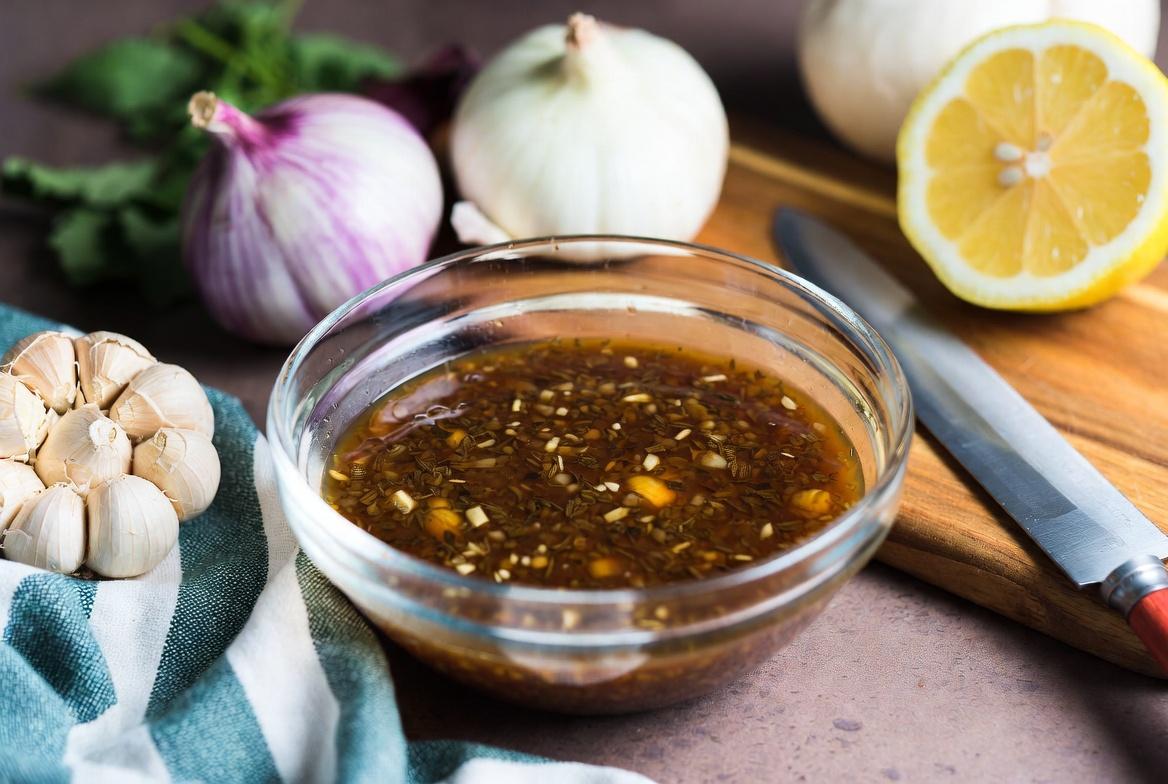
The basic ratio: 3 parts oil : 1 part acid : aromatics to taste : salt to season
From there, the decisions are:
-
What type of acid fits the cuisine? Citrus for bright, light preparations. Vinegar for boldness and depth. Dairy for gentle tenderization and protection against high heat. Wine for refinement and complexity.
-
What's the dominant flavor story? Mediterranean (olive oil, lemon, oregano, garlic)? Southeast Asian (fish sauce, lime, ginger, chili)? Middle Eastern (yogurt, cumin, coriander, harissa)? North African (olive oil, preserved lemon, herbs, spice)? These are just starting points — the world of marinade flavors is essentially the entire world of cooking.
-
How long will it marinate? Adjusts your acid concentration accordingly.
-
What's the cooking method? Grill benefits from oil-rich marinades and sugar for charring. Pan-sear needs the surface dry. Oven roasting is forgiving of most marinade types.
Once you internalize the ratio and the variables, the recipe stops being a constraint and starts being a canvas.
Beyond Meat — Marinades for Vegetables, Tofu, and Grains
The marinade conversation is heavily meat-centric, but some of the most dramatic flavor transformations happen with plant-based proteins and vegetables.
Tofu has a porous, open cell structure that makes it an exceptional marinade sponge — especially after pressing out excess moisture. A bold marinade (soy, ginger, sesame, garlic, rice vinegar) left for two to four hours completely transforms its flavor from bland to deeply savory.
Portobello mushrooms absorb oil-and-herb marinades rapidly. Their surface area and cellular structure makes 30 minutes sufficient. Balsamic-garlic is a classic pairing for a reason.
Root vegetables — beets, carrots, sweet potato — hold up to bold, acidic marinades and actually benefit from 1–2 hours of contact before roasting, which drives more flavor into their dense flesh.
Legumes and grains are not typical marinade candidates, but dressing cooked chickpeas, lentils, or farro in a well-built vinaigrette immediately after cooking — while still warm and porous — produces the same flavor penetration effect as marinating raw protein.
The Regional Worldview — Marinades as Cultural Identity
Every culture that cooks meat has developed a signature marinade tradition, and each reflects the local ecology of ingredients.
The Greek souvlaki marinade — olive oil, lemon, dried oregano, garlic — is optimized for lamb and the intense heat of wood fire. The acid is light, the oil is heavy, and the herb is robust enough to survive open flame.
Korean bulgogi balances soy sauce, Asian pear or kiwi (natural tenderizers via fruit enzymes), sesame oil, garlic, ginger, and sugar. The pear enzymes are a sophisticated tenderizing technique that Western cooking rarely matches.
Jamaican jerk is a paste marinade built around Scotch bonnet peppers, allspice, thyme, and garlic — fiery, fragrant, and designed for slow smoking. The complex spice profile is the whole point.
Indian tandoori uses thick yogurt as its base, layered with turmeric, red chili, coriander, cumin, and garam masala. The yogurt's lactic acid is gentle, and the thick coating protects the meat from the 900°F+ heat of a traditional tandoor.
Peruvian anticucho marinates beef heart in aji amarillo paste, cumin, and vinegar — a direct line to pre-Columbian cooking traditions. The vinegar is bold, the spice is vivid, and the result is one of the most flavorful street foods on the planet.
The Takeaway: Respect the Chemistry, Trust the Process
A marinade rewards attention. Not complexity for its own sake, not more ingredients layered on top of each other, but a clear-eyed understanding of what each component does and why.
Acid tenderizes and penetrates — used too aggressively, it damages. Oil carries flavor and protects — used without aromatics, it coats without contributing. Aromatics build the flavor story — used without fat, they remain at the surface, unable to do their best work.
When those three things work together in the right proportion, with the right protein, for the right amount of time, something happens that is genuinely difficult to replicate any other way. The food doesn't just taste seasoned. It tastes transformed — like the flavors were always inside it, waiting to be released.
That's the quiet alchemy of a well-built marinade. And once you understand it, you'll never marinate by guesswork again.