There's a moment every backyard cook knows well. The coals look perfect — glowing orange, dusted in grey ash, radiating that shimmer of heat you can feel from three feet away. You lay down the steak. And then something goes wrong. It flares up. It burns on the outside before the inside is done. Or it just sits there, steaming rather than searing, producing a pale grey crust instead of the deep mahogany bark you wanted.
The problem isn't the meat. It's the physics.
Grilling sits at the intersection of combustion chemistry, fluid dynamics, and thermodynamics. Most people treat it like folklore — tips passed down through generations, half-remembered from a cookout twenty years ago. But underneath every perfect crust, every smoke ring, every piece of chicken that's juicy through to the bone, there's a set of principles that can be learned, understood, and applied with intention. Once you know how heat actually behaves — how it moves, how it's generated, how different fuels produce different results — the grill becomes a precision tool rather than a source of anxiety.
Let's break it down.
The Three Modes of Heat Transfer — And Why All Three Are Happening at Once
Heat moves through three distinct mechanisms: conduction, convection, and radiation. On a grill, all three are happening simultaneously. Understanding what each one does to your food changes how you position it, when you flip it, and how you manage your fuel.
Conduction — Direct Contact, Instant Impact
Conduction is the transfer of heat through direct physical contact. When a steak hits a hot cast-iron grate, conduction is responsible for those dark sear marks. The metal — which stores and transfers thermal energy efficiently — donates heat directly to the protein surface.
The speed of conduction depends on two things: the temperature differential between the grate and the food, and the thermal conductivity of the material involved. Cast iron conducts heat more evenly than thin stainless steel, which is why cast-iron grates produce more uniform sear marks. If your grates are cold (or you haven't preheated long enough), conduction stalls, and the food begins to steam in its own moisture before any browning occurs.
This is why the "cold grate" problem is so persistent. A grate that hasn't been heated for at least 10–15 minutes isn't ready to conduct heat fast enough to trigger the Maillard reaction — the chemical process responsible for browning, crust formation, and flavor development — before the surface moisture evaporates and the exterior begins to stew.
Convection — The Air Around Your Food Is Cooking It
Convection is heat transfer through fluid movement, and in grilling, that fluid is air. When you close the lid of your grill, you create a convective oven. Hot air circulates around the food, cooking the surfaces that aren't in contact with the grate, speeding up internal temperature rise, and creating a more uniform cook.
Open-lid grilling is almost entirely conductive and radiant. Closed-lid grilling introduces convection as a third force. This is why a whole chicken on a kettle grill cooks beautifully with the lid on — the convective heat reaches the top of the bird even as the bottom receives radiant and conductive heat from below.
The temperature of that circulating air is heavily influenced by airflow, which we'll come back to in detail. But the key insight is this: the lid is not just a cover — it's an active cooking tool.
Radiation — The Heat You Feel Without Touching Anything
Radiation is electromagnetic heat transfer — the warmth you feel when you hold your hand over glowing coals without touching them. Infrared radiation travels in straight lines from the heat source and is absorbed by whatever it hits first: food, grates, or the interior walls of the grill.
Radiant heat is responsible for the deep, direct sear you get on meat positioned directly above coals or a gas burner. It's also responsible for flare-ups: fat dripping onto a heat source generates intense bursts of radiant energy from the igniting grease. Those flare-ups can blacken the exterior of food almost instantly while the interior remains cold.
Managing radiant heat is mostly a matter of distance. Moving food further from the source reduces radiant intensity rapidly — radiant heat follows the inverse square law, meaning double the distance equals one-quarter the intensity.
The Role of Fire — What's Actually Happening When Something Burns
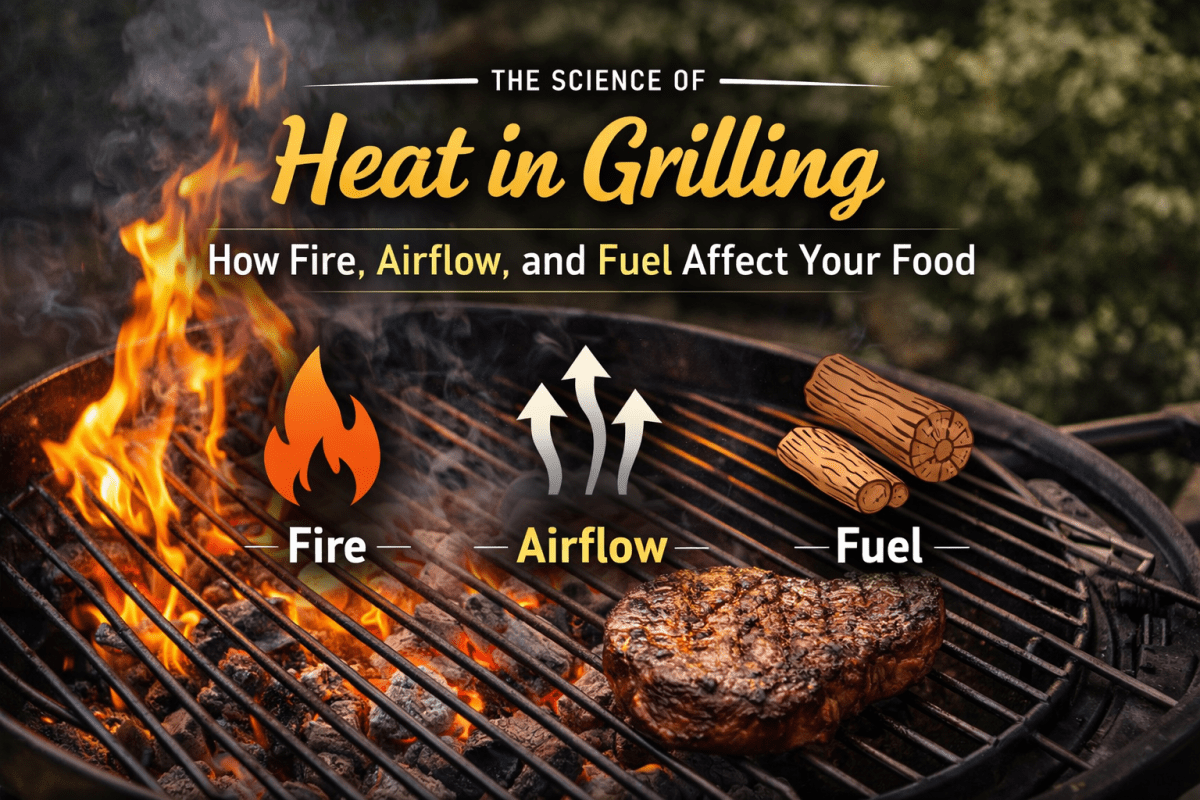
Fire is a chemical reaction — specifically, a rapid oxidation process that releases heat, light, carbon dioxide, and water vapor. In grilling, the fuel (charcoal, wood, or gas) reacts with oxygen to produce heat. The efficiency and character of that reaction determines what kind of heat you're working with.
Combustion Stages and Why They Matter
Wood and charcoal pass through distinct combustion stages. In the early phase, moisture is driven off and the fuel begins to char. This produces smoke — some of it flavorful, some of it acrid and bitter depending on the compounds being released. The middle combustion phase is where clean, efficient burning happens: the carbon in the fuel oxidizes completely, producing heat and minimal smoke. The final phase is glowing ember combustion — the long, steady, radiant heat that experienced grillers prize.
If you're cooking over a live flame rather than settled coals, you're cooking in an inconsistent environment. The flame produces variable radiant heat, more acrid smoke, and unpredictable flare-ups. Patient cooks wait for the coal bed to develop properly — at least 20–25 minutes after lighting — before putting food on. That grey-ash coating on charcoal isn't just aesthetic. It's the signal that the coal has moved past its flaring stage into efficient radiant output.
Fuel Temperature Ceilings
Different fuels produce heat at different peak temperatures. The type of fuel you choose determines the ceiling of what's physically possible in terms of searing power.
This is one of the most practically significant differences between gas and charcoal — not just flavor, but thermal capacity. Charcoal burns hotter, which is why steakhouse-style searing is difficult to replicate on standard residential gas grills.
Airflow — The Most Underestimated Variable in Grilling
Ask most people what controls the temperature on a charcoal grill and they'll say "how much charcoal you use." That's partially true. But the real lever is airflow.
Oxygen as the Throttle
Fire needs oxygen to burn. More oxygen equals faster combustion equals more heat. Less oxygen slows combustion, drops temperature, and — if reduced far enough — extinguishes the fire entirely. On a charcoal grill, airflow is controlled through vents: typically a bottom vent that allows fresh air in and a top vent that allows combustion gases and smoke to escape.
Opening both vents fully creates a chimney effect — air rushes in at the bottom, heated gases rise and exit at the top, and the fire burns hot and fast. This is the configuration for high-heat searing.
Partially closing the bottom vent restricts incoming oxygen, slowing combustion and lowering the temperature — useful for low-and-slow cooking.
Closing the top vent is different. It restricts the exhaust of combustion gases, which can create a build-up of CO2 and CO inside the grill that suppresses combustion more aggressively than the bottom vent alone.
Most experienced grillers modulate temperature primarily with the bottom vent and use the top vent to control smoke retention and draft.
How Airflow Affects Smoke and Flavor
The relationship between airflow and smoke flavor is often misunderstood. More smoke does not equal more flavor. The quality of smoke matters far more than quantity.
Clean smoke — sometimes called "blue smoke" — is thin, almost invisible, and slightly blue-tinged. It contains flavor compounds like guaiacol and syringol that interact with meat proteins to produce the classic barbecue flavor profile. This type of smoke is produced by efficient, oxygen-rich combustion.
Thick white or grey smoke is a sign of incomplete combustion. It's laden with creosote, unburned particulates, and bitter compounds that coat the exterior of food in an acrid layer. You've tasted this on meat that had an overwhelming, harsh smokiness with a slightly chemical aftertaste — that's creosote at work.
Maintaining adequate airflow through your fire ensures you're producing clean smoke rather than dirty smoke. On offset smokers, this is a constant calibration of firebox airflow versus exhaust draft. On kettle grills, it means not strangling the vents in an attempt to "add more smoke time" — because starved combustion produces worse smoke, not better.
Fuel Comparison — Charcoal vs. Gas vs. Wood vs. Pellets
The fuel debate in grilling carries the kind of passion typically reserved for politics. But underneath the tribalism are real, measurable differences in heat characteristics, flavor output, and control.
| Feature | Lump Charcoal | Briquettes | Natural Gas | Propane | Wood | Pellets |
|---|---|---|---|---|---|---|
| Peak Temperature | 900–1,200°F | 700–900°F | 500–650°F | 550–700°F | 800–1,000°F | 450–600°F |
| Heat Consistency | Variable | High | Very High | Very High | Variable | High |
| Smoke Flavor | Moderate | Low-Moderate | None | None | High | Moderate-High |
| Ease of Temperature Control | Moderate | Moderate | Excellent | Excellent | Difficult | Excellent |
| Preheat Time | 20–30 min | 25–35 min | 5–10 min | 5–10 min | 30–60 min | 10–15 min |
| Burn Duration | 45–90 min | 60–120 min | Continuous | Continuous | 45–90 min | Continuous |
| Moisture Impact on Food | Low | Low | Moderate (vapor) | Moderate (vapor) | Low | Low |
| Cost (approximate) | $1.50–$3/lb | $0.75–$1.25/lb | $0.10–$0.20/hr | $0.20–$0.40/hr | $1–$4/lb | $0.50–$1.50/lb |
| Environmental Impact | Moderate | Moderate-High | Low-Moderate | Moderate | Low (sustainable wood) | Low-Moderate |
| Best Use Case | High-heat searing | Long cooks | Everyday versatility | Everyday versatility | Smoking, campfire | Low-and-slow BBQ |
Why Lump Charcoal Burns Hotter Than Briquettes
Lump charcoal is carbonized wood with minimal additives — essentially wood that's been heated without oxygen until it's pure carbon. It lights faster, burns hotter, and produces less ash than briquettes.
Briquettes are engineered products: a mix of charcoal dust, binding agents (typically starch), and sometimes accelerants or additives to aid lighting. The binders and fillers lower the energy density of briquettes compared to pure lump charcoal, which is why their peak temperatures are lower. However, the uniform shape and density of briquettes means they burn more consistently — a more even coal bed with more predictable heat output. For long, low-temperature cooks, the consistency of briquettes often outperforms the variability of lump.
What Gas Grills Do Differently (And Why That's Not a Weakness)
The gas vs. charcoal debate often frames gas as the inferior option. That's a misread of the science. Gas grills offer a level of temperature control that charcoal cannot match. The ability to dial in 350°F and hold it there with precision is genuinely useful for cooking chicken thighs, fish, or vegetables where consistent, moderate heat is optimal.
What gas lacks is peak thermal capacity and the Maillard-reaction-enhancing effect of radiant coal heat. When fat drips onto a gas burner's ceramic flavorizer bars, you get brief smoke — but it's not the same character as wood-smoke compounds.
Gas also produces water vapor as a combustion byproduct (natural gas is primarily methane — CH₄ + 2O₂ → CO₂ + 2H₂O). This ambient moisture slightly inhibits surface crust formation, which is one reason steaks on gas grills often have a slightly softer crust than charcoal-cooked equivalents, all else being equal.
Temperature Zones — The Two-Zone Setup and Why It Works
One of the most important principles in grilling heat management is the concept of temperature zones. Rather than treating the grill as a single uniform cooking surface, skilled grillers create distinct heat zones that serve different functions.
Direct vs. Indirect Heat
Direct heat means food is positioned above the heat source. Radiant and conductive heat hit the food aggressively, producing rapid browning and searing. This is appropriate for thin cuts, burgers, hot dogs, vegetables, and anything that can cook through in 10 minutes or less without burning.
Indirect heat means food is positioned away from the heat source, cooking primarily through convection in a closed-lid environment. This is the approach for thicker cuts, whole poultry, roasts, and anything that needs internal temperatures above 145°F without charring the exterior.
The two-zone setup — coals banked to one side on charcoal, one or two burners lit on gas — gives you both options simultaneously. Sear over direct heat, then move to indirect heat to finish cooking without burning. This approach eliminates the most common grilling failure mode: exterior charred, interior raw.
The Reverse Sear — Applying Heat Science in Reverse
The reverse sear flips the conventional sequence. Rather than searing first and finishing in indirect heat, you cook the protein slowly in indirect heat until it's within 10–15°F of the target internal temperature, then sear over direct high heat to develop the crust.
The scientific advantage is significant. Slow indirect cooking dries the surface of the meat slightly while bringing the interior to an even temperature throughout. When you then hit it with direct heat, the dry surface browns faster, more evenly, and more intensely — because surface moisture (which requires energy to evaporate before browning can begin) has already been minimized.
The Maillard reaction begins around 280–330°F on the food's surface. A wet surface keeps the exterior below boiling point (212°F) until enough moisture evaporates. A pre-dried surface reaches browning temperatures faster with less time over direct heat, giving you more control and less risk of overcooking the interior.
Practical Heat Management — Putting the Science to Work
Calibrate Before You Cook
Every grill is different. A grill thermometer mounted in the dome gives you air temperature but not grate temperature — these can differ by 50–100°F. An infrared thermometer pointed at the grate itself gives you the most accurate read of conductive cooking potential. Get one. It costs $20 and removes one of the most significant variables in grilling.
Preheat With Purpose
Preheat time is not optional. Charcoal needs 20–30 minutes. Gas needs 10–15 minutes with the lid closed. Cast-iron grates need longer than stainless because they hold more thermal mass that must be brought up to temperature. Cutting preheat time short means you're grilling on a heat-deficient surface that will drop temperature rapidly the moment cold food hits it.
Manage Moisture on the Food Surface
Patting proteins dry before they hit the grate is not just a chef's affectation — it's applied physics. Surface moisture must be evaporated before the surface temperature can exceed 212°F. Every drop of water on the surface delays browning. Dry the surface, and the Maillard reaction starts faster.
Resist the Urge to Press and Poke
Pressing a burger or steak into the grate forces moisture out of the meat and onto the hot surface, creating steam that impedes crust formation and results in moisture loss. The sizzle feels satisfying. The result is drier meat with a compromised crust. Let conduction do its work without interference.
Rest Your Meat
Resting cooked meat isn't myth — it's thermodynamics. When meat comes off heat, muscle fibers that contracted under heat begin to relax. The temperature gradient between the hot exterior and cooler interior continues to equilibrate through residual conduction. Cutting immediately causes pressurized juices to escape in volume. Resting for 5–10 minutes (for steaks) to 20–30 minutes (for large roasts) allows that equilibration to complete, resulting in more evenly distributed moisture throughout the slice.
The Smoker Distinction — When Low and Slow Becomes a Science of Its Own
Hot smoking — the kind used in barbecue — operates in a different thermal regime entirely. Where grilling targets 400–700°F grate temperatures, smoking targets 225–275°F air temperatures sustained over hours. The science shifts from Maillard chemistry (browning) toward collagen conversion (tenderness).
Collagen — the connective tissue abundant in tough cuts like brisket, pork shoulder, and ribs — begins converting to gelatin at around 160°F, but this conversion is time-dependent. At low temperatures, collagen conversion happens slowly, giving the muscle fibers time to break down without the aggressive contraction that happens at high heat. The result is meat that pulls apart rather than chewing hard.
The smoke ring — that pink halo just beneath the surface of smoked meat — is a chemical marker, not a flavor indicator. It's formed when nitrogen dioxide from the combustion gases reacts with the myoglobin in meat to form nitrosomyoglobin, which is heat-stable and stays pink. More smoke ring doesn't mean more smoke flavor, though the two often correlate because both result from extended smoke exposure.
Bottom Line — Heat Is a System, Not a Setting
The most important shift in grilling perspective is moving from thinking about heat as a single dial to thinking about it as a system. Fire, fuel, airflow, grate temperature, food moisture, hood position — all of these interact. Pull one lever and others respond.
Great grilling isn't about following recipes. It's about understanding what heat is doing to your food at every moment, and adjusting accordingly. The cook who knows why a flare-up happens — and what to do about it — is working with fundamentally more competence than the one simply following a timer.
Once you internalize the science, you stop fearing the grill and start having a conversation with it. And that conversation, when you get it right, ends with the kind of food that doesn't need explanation.
Understanding your heat source is the first step. Everything else — seasoning, technique, timing — builds on that foundation.