The Sauce Is the Soul
There is a moment at every great backyard cookout — right when the lid comes off the grill, smoke billows into the evening air, and that first waft of something caramelized and deeply savory hits you — when you understand, on a primal level, why humans have been cooking meat over fire for hundreds of thousands of years. But here's what separates a good barbecue from a transcendent one: the sauce.
BBQ sauce is not a condiment. Not really. It's a philosophy. A regional declaration. A family argument rendered in liquid form. In the American South alone, wars have nearly been fought over whether a proper sauce should be tomato-based or vinegar-based, thin or thick, sweet or fire-hot. Travel a few hundred miles in any direction across this country and the BBQ sauce changes entirely — as distinct from its neighbor as one dialect is from another.
This guide is a deep dive into the world of BBQ sauces: how they're built, where they come from, what makes them work, and how you can use that knowledge to cook better, eat better, and — perhaps most importantly — argue more convincingly at the grill.
Understanding the Anatomy of a BBQ Sauce
Before you can appreciate regional variations or experiment with your own recipes, you need to understand what a BBQ sauce actually does. A sauce has four primary jobs: add flavor, add moisture, create a lacquer-like bark through caramelization, and deliver contrast to the richness of the meat.
Every BBQ sauce, regardless of where it comes from or what it tastes like, is built on a framework of five taste elements:
Sweetness — Usually from brown sugar, molasses, honey, maple syrup, fruit preserves, or even Coca-Cola. Sweetness rounds out harsh edges and promotes caramelization (the Maillard reaction) on the grill surface.
Acid — Vinegar, citrus juice, Worcestershire sauce, or tomatoes provide brightness. Acid cuts through fat and keeps the sauce from tasting flat or cloying.
Heat — Cayenne, black pepper, crushed red pepper, hot sauce, jalapeño, chipotle. Heat adds dimension and keeps the palate interested.
Savory/Umami — Mustard, garlic, onion, soy sauce, Worcestershire, and smoke itself. This is the backbone, the thing that makes a sauce taste like food rather than a condiment.
Fat or Body — Butter, olive oil, or the natural thickening from reduced tomatoes. Body gives the sauce something to cling to meat with.
The genius of a great BBQ sauce is in the balance and proportion of these five elements. Tip any one of them too far and the whole thing unravels.
The Great Divide — Wet vs. Dry Barbecue
Before getting into sauces themselves, it's worth acknowledging that not everyone agrees sauce is even necessary. The dry rub camp — particularly centered in Memphis, Tennessee — argues, with some righteousness, that a well-seasoned piece of meat slow-cooked over real wood needs nothing poured over it afterward.
Dry rubs are blends of salt, pepper, sugar, paprika, garlic powder, onion powder, and whatever else the pitmaster sees fit. Applied to meat hours or days before cooking, they create a dense, intensely flavored bark through long, slow cooking. Memphis dry-rub ribs are extraordinary precisely because the flavor is in the meat, not on top of it.
But the wet tradition is older, more widespread, and frankly more diverse. Sauces protect meat from drying out, add layers of complexity that no rub can fully replicate, and — let's be honest — they look spectacular dripping off a rack of ribs or pooling under a pile of pulled pork.
The modern consensus: use both. Dry rub the meat before cooking, then apply sauce during the last 15–20 minutes on the grill, or serve it on the side. This gives you the bark of a dry-rub approach with the gloss and complexity of a wet sauce.
Sweet BBQ Sauces — Kansas City's Gift to the World
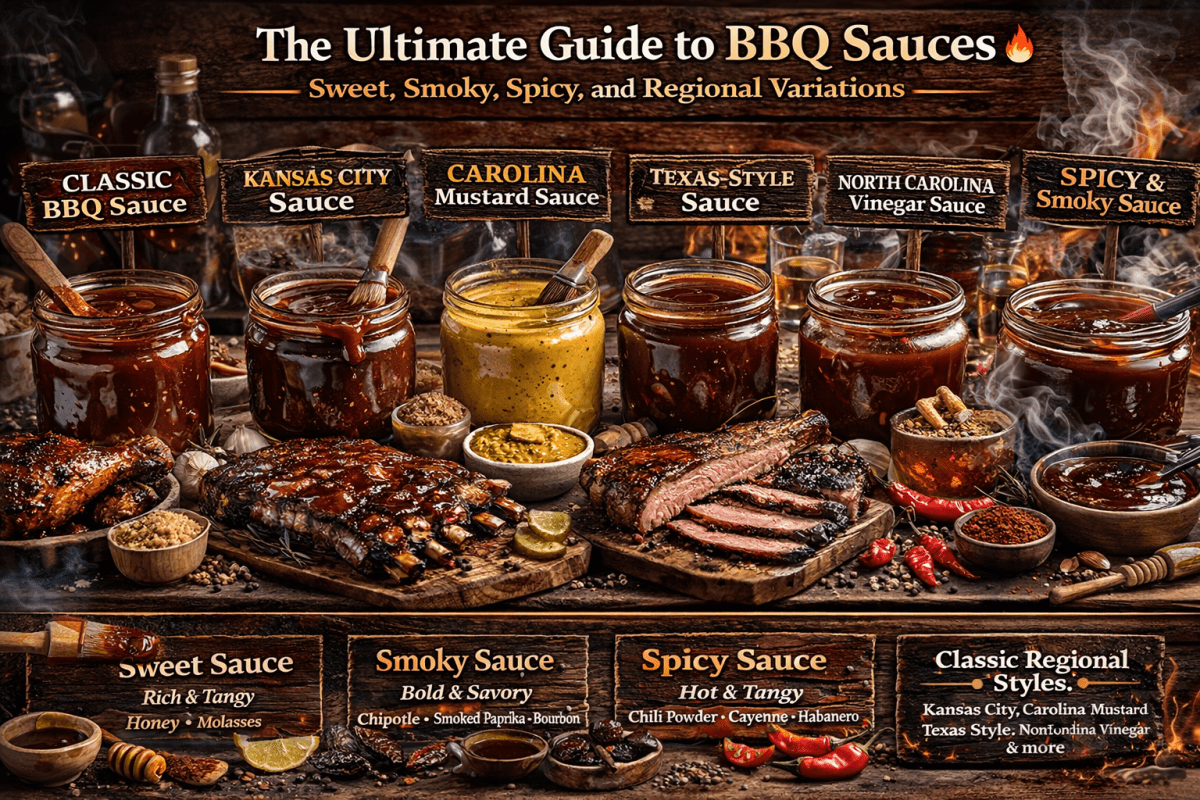
If you've ever eaten a rack of ribs in middle America and come away with sauce on your elbows, you've encountered the Kansas City style. This is the sauce that most Americans think of when they think of BBQ sauce — thick, glossy, deeply red-brown, aggressively sweet, with a long, slow burn at the finish.
Kansas City BBQ sauce is built on a tomato-ketchup base layered with molasses and brown sugar, balanced with cider vinegar, and deepened with garlic, onion, black pepper, and often a touch of liquid smoke. The result is viscous, almost syrupy, and extraordinarily good at creating a charred, lacquered crust on ribs or chicken.
The style traces back to Henry Perry, often called the "father of Kansas City BBQ," who started selling slow-smoked meats from a streetcar barn in 1908. His influence shaped an entire regional tradition that now defines barbecue for most of the world.
Key characteristics of Kansas City sauce:
- Thick, ketchup-based body
- Heavily sweetened with molasses or brown sugar
- Moderate heat, often from black pepper and cayenne
- Balanced acidity from cider vinegar
- Rich, dark color from slow caramelization
Best paired with: Beef brisket, pork ribs, pulled pork, smoked chicken thighs.
Pro tip: Because of its high sugar content, Kansas City sauce burns quickly over direct heat. Always apply it during the last 10–15 minutes of cooking, or serve it tableside.
Vinegar-Based Sauces — Eastern North Carolina's Sharp Truth
Travel east from Kansas City and everything changes. In eastern North Carolina, the sauce has been stripped down to its most elemental form: cider vinegar, crushed red pepper flakes, black pepper, salt, and sometimes a whisper of sugar. That's it. No tomatoes. No ketchup. No molasses. Just sharp, bright, functionally aggressive acid.
To outsiders, eastern North Carolina sauce can taste like a prank. To locals, any other style tastes like dessert. The sauce is designed specifically for the region's whole-hog barbecue tradition, where pigs are cooked low and slow over hardwood coals for 12 hours or more. The resulting meat is rich, fatty, and intensely smoky — it needs something acidic and sharp to cut through it. That thin vinegar sauce does exactly that.
It also serves a practical function that predates refrigeration: vinegar is a preservative. In the days before coolers and food storage, a vinegar-based sauce helped keep cooked pork safe to eat for longer.
Key characteristics of eastern NC sauce:
- Thin, almost watery consistency
- Pure cider vinegar base
- Heat from crushed red pepper and black pepper
- No sweetness or very minimal sugar
- Extremely bright, sharp flavor
Best paired with: Whole-hog pulled pork, pork shoulders, smoked turkey.
Pro tip: Use this sauce as a finishing sauce — drizzle it directly onto the pulled pork as it's being chopped or pulled, so the vinegar soaks into the meat rather than sitting on top of it.
Tomato-Vinegar Hybrid — Western North Carolina Draws a Line
Move 200 miles west within the same state and the sauce changes dramatically. Western North Carolina — centered around Lexington — introduces ketchup or tomato paste into the vinegar base. The result is thicker, slightly sweeter, and redder than its eastern cousin, though it still retains that vinegar brightness.
This is called Lexington-style or Piedmont-style sauce, and it sits in an interesting middle ground between the pure vinegar of the east and the thick sweetness of Kansas City. It's the style that most BBQ chains north of the Mason-Dixon line have borrowed and diluted into something barely recognizable.
At its best, though, it is wonderfully versatile — complex enough to stand on its own but still deferential enough to let the meat do the talking.
Mustard Sauces — South Carolina's Golden Standard
Here is where things get genuinely interesting. Drive through the central part of South Carolina — the Midlands region, roughly between Columbia and Charleston — and you'll encounter something completely unexpected on your BBQ: a bright yellow, mustard-based sauce that has no real analog anywhere else in the country.
South Carolina mustard sauce is tangy, sharp, and weirdly compelling. Its base is yellow mustard (French's, typically) combined with cider vinegar, brown sugar, and black pepper. The sauce is thin enough to pour but thick enough to coat. It tastes like nothing else.
The origin is almost certainly German. In the 18th century, a significant wave of German immigrants settled the South Carolina Piedmont region, bringing with them a deep cultural affinity for mustard. Combined with the existing Southern tradition of slow-cooked pork, the result was a mustard-sauced BBQ tradition that has persisted for over 250 years.
Key characteristics of SC mustard sauce:
- Yellow mustard base
- Sharp acidity from cider vinegar
- Moderate sweetness from brown sugar or honey
- Black pepper for heat and bite
- Brilliant golden-yellow color
Best paired with: Pork ribs, pulled pork, smoked sausage, grilled chicken.
Pro tip: Don't be tempted to substitute Dijon or spicy brown mustard in a traditional recipe — the flatness of yellow mustard is intentional and necessary to let the vinegar and sugar shine.
Smoky BBQ Sauces — Chasing the Fire Itself
Some sauces lead with sweetness. Others lead with acid. The most seductive, arguably, are the ones that lead with smoke — sauces so deeply infused with that char and campfire essence that eating them feels almost primordial.
True smokiness in a sauce can come from several sources:
Chipotle peppers — Dried, smoked jalapeños in adobo sauce are perhaps the most accessible route to genuine smoke flavor. They contribute both heat and a rich, earthy smoke that holds up beautifully in tomato-based sauces.
Smoked paprika — Spanish pimentón de la Vera is cold-smoked over oak and carries an extraordinary depth of smoky flavor. Two tablespoons of good smoked paprika transforms an ordinary sauce into something that tastes like it's been sitting in a smokehouse for days.
Liquid smoke — The most controversial ingredient in BBQ. Used with restraint, it adds an authentic hickory or mesquite note. Used carelessly, it makes food taste like an ashtray. The rule: start with a quarter teaspoon, taste, and proceed from there.
Actual smoke — The best method, and the most effort. Finish your sauce in a cast-iron pan on the grill itself while the meat is cooking, and it will pick up genuine smoke from the ambient environment.
Texas, which treats smoke as essentially a religion, is perhaps the most interesting case study in smoke-forward BBQ. Central Texas sauce — if it exists at all, since many joints consider sauce unnecessary — is thin, peppery, and deeply savory, designed not to compete with but to amplify the flavor of brisket that's been smoking over post oak for 14 hours.
Spicy BBQ Sauces — From Gentle Heat to Pure Fire
There is a subset of BBQ sauce devotee who considers sweetness a mild annoyance and smoke a pleasant distraction, but who comes alive the moment capsaicin enters the picture. For this person, the heat is not an accent — it is the point.
Spicy BBQ sauces occupy a wide spectrum. At the gentle end, you have sauces that incorporate cayenne or black pepper in enough quantity to create a slow-building warmth at the back of the throat. At the extreme end, you have sauces built around ghost peppers, habaneros, or Carolina Reapers — sauces that are more chemistry experiment than cooking, and that require a glass of milk kept within arm's reach.
The most successful spicy BBQ sauces — the ones that work as actual food rather than just endurance tests — are the ones that layer heat intelligently. A sauce might start with the fruity, immediate punch of habanero, followed by the slow burn of cayenne, followed by the deep, lingering warmth of chipotle. Each layer of heat arrives at a different moment on the palate, creating a dynamic, evolving experience rather than a single blunt assault.
Building a balanced spicy sauce:
- Start with a foundational heat from black pepper or cayenne
- Layer in a fruity heat from fresh or dried chiles (habanero, serrano, jalapeño)
- Add depth with smoked or dried chiles (chipotle, ancho, guajillo)
- Balance with sweetness — heat needs sweetness the way music needs rhythm
- Add acid to keep everything bright and alive
Nashville Hot, while technically a dry spice paste applied to fried chicken, has influenced an entire genre of spicy BBQ sauces that blend cayenne heat with lard, brown sugar, garlic, and paprika — a combination that is simultaneously punishing and addictive.
Regional Wildcards — The Sauces No One Talks About Enough
Beyond the classic American regional traditions, there are sauce styles that deserve far more attention than they typically receive.
Alabama White Sauce One of the most genuinely strange and wonderful things in American BBQ. White sauce — created by Big Bob Gibson in Decatur, Alabama, in 1925 — is a mayonnaise-based sauce with horseradish, cider vinegar, black pepper, and lemon juice. It is cold, creamy, tangy, and slightly spicy, and it works on smoked chicken in a way that no red sauce can quite match. The fat in the mayonnaise carries flavor compounds across the palate in a fundamentally different way than a water-based sauce, and the horseradish creates a sinus-clearing brightness that is entirely unique.
Hawaiian Huli Huli Sauce Huli huli means "turn turn" in Hawaiian — a reference to the constant rotation required when grilling chicken over open flames. The sauce itself is built on pineapple juice, soy sauce, ginger, garlic, brown sugar, and sesame oil. The result is sweet, salty, slightly tart, and extraordinarily good at caramelizing on chicken. It belongs in the same conversation as any Southern regional sauce, and it doesn't get there nearly often enough.
Texas Mop Sauce Not a finishing sauce but a basting sauce — thin enough to apply with an actual mop brush during the long hours of smoking. Typically made from butter, beef broth, cider vinegar, Worcestershire, garlic, and black pepper, a Texas mop sauce keeps large cuts of meat moist and adds gradual layers of flavor over many hours of cooking.
St. Louis Style Sitting somewhere between Kansas City and Memphis, St. Louis sauce is tomato-based and moderately sweet but notably thinner than KC style. It tends to incorporate more Worcestershire and garlic, and it has a slightly more savory profile. Not as famous as its neighbors, but quietly excellent.
How to Build Your Own Signature BBQ Sauce
The most rewarding thing you can do with this knowledge is put it to work in your own kitchen. Building a BBQ sauce from scratch is genuinely one of the most forgiving and creatively satisfying things a home cook can do — the margins for error are wide, the ingredients are inexpensive, and the payoff is enormous.
The framework:
-
Choose your base. Ketchup/tomato paste for a classic American sauce. Yellow mustard for a South Carolina-style. Cider vinegar alone for a North Carolina approach. Mayonnaise for Alabama white.
-
Add your sweetener. Brown sugar for depth and molasses character. Honey for floral notes. Maple syrup for complexity. Start with 2–3 tablespoons and adjust.
-
Add your acid. Cider vinegar is the most versatile. White wine vinegar for a lighter touch. Fresh citrus for brightness. The acid should make the sauce taste alive.
-
Build your savory layer. Worcestershire sauce, soy sauce, garlic, onion — these are the backbone. Don't skip them.
-
Add heat. Cayenne for clean, direct heat. Chipotle for smoky heat. Fresh hot sauce for vinegar-forward heat. Go carefully — you can always add more.
-
Simmer and reduce. Twenty minutes on medium-low heat concentrates flavors, melds the components, and thickens the sauce. Taste obsessively throughout.
-
Finish with butter. Optional but transformative. A tablespoon of cold butter whisked in off the heat adds gloss, richness, and a professional quality to the final texture.
Rest overnight. BBQ sauce always tastes better the next day. The flavors knit together in a way that no amount of cooking fully replicates. If you can make your sauce 24 hours ahead, do it.
Pairing Sauces to Meat — The Essential Guide
The wrong sauce on the right meat is a genuine tragedy. Here's a quick pairing framework based on flavor intensity and fat content:
Beef brisket — Needs something that doesn't compete with the meat's deep, iron-rich flavor. Thin Texas mop or a moderately sweet KC-style with a strong black pepper note.
Pulled pork — Rich and fatty, so it needs acid. Eastern NC vinegar sauce or a Lexington hybrid are traditional for reason.
Pork ribs — The most sauce-versatile cut. Kansas City sweet, mustard-based, or a spicy chipotle blend all work beautifully depending on cooking method.
Chicken — A tricky protein because it's lean and can taste flat under a heavy sauce. Alabama white sauce, a honey-based glaze, or a huli huli marinade all add fat and flavor without overwhelming the meat.
Lamb — Underused in BBQ, and spectacular. A harissa-influenced sauce — North African-style with preserved lemon, cumin, and roasted red pepper — complements lamb's gaminess in a way that KC sweetness simply cannot.
Smoked sausage — A sharp mustard sauce or a spicy vinegar-based sauce cuts through the fat and snaps the flavors into focus.
The Future of BBQ Sauce
American BBQ is in an extraordinary moment of creative ferment. A generation of pitmasters raised on both Southern tradition and global cuisine is producing sauces that genuinely defy category. Korean gochujang is finding its way into brisket glazes. Tamarind paste is deepening vinegar-based sauces. Japanese tare — a thick, soy-based sauce typically used for yakitori — is being adapted for smoked chicken in ways that are sophisticated and surprising.
Meanwhile, the craft condiment industry has democratized small-batch sauce production, meaning that a two-person operation in Alabama or a backyard pitmaster in Oregon can now reach national audiences with genuinely exceptional regional products.
What has not changed, and will not change, is the fundamental dynamic: sauce exists to serve the meat. The best BBQ sauce in the world is the one that makes the thing underneath it taste more fully and completely like itself — not a sauce that announces its own cleverness while the brisket goes unnoticed.
Final Thoughts — Own Your Sauce
Every serious cook eventually develops a sauce that is fully and specifically their own. It might start as a Kansas City base with a few adjustments — a little more cider vinegar here, a chipotle or two there — and evolve over years into something that genuinely reflects a specific palate, a specific kitchen, a specific history.
That evolution is the point. BBQ sauce is not a finished product you buy at the store and pour from a bottle. It's an ongoing argument between tradition and experimentation, between what your grandmother made and what you tasted at that roadside stand in Tennessee, between the fire on the grill and the sweet dark sauce pooling on the plate.
Get in the argument. Start with what you know. Change one thing at a time. Write nothing down at first — let the muscle memory develop. Then, when you've made something that stops the conversation at the table, then write it down.
That recipe is worth keeping.
Whether you're smoking a packer brisket low and slow over post oak or grilling chicken thighs on a Wednesday night, the right sauce isn't just an addition to the plate — it's the final word in a conversation that started the moment you lit the coals.